
Key takeaways
- AI-generated answers now sit between your buyers and your website. When a summary appears on Google, people click a regular result about half as often.
- Generative engine optimization (GEO) is the work of making your business easy for AI systems to find, understand, trust and cite. It builds on SEO; it does not replace it.
- Peer-reviewed research found that adding statistics, quotations and cited sources raised visibility in AI answers by up to 40%, while keyword stuffing made it worse.
- Start with consistent business information, one clear page per service, real evidence and third-party mentions. Then measure monthly with the same set of prompts.
A homeowner in Austin asks an AI assistant which dental implant clinics are worth considering. A finance director in Bogotá asks which accounting firms specialize in mid-size companies. Neither one opens ten blue links. They read a short answer with three or four names, maybe click one, and move on.
If your company is not in that answer, you were not compared and rejected. You were never considered. This guide explains what changed, what the research says actually improves your odds of being cited, and a 30-day plan you can run without a large budget.
What changed: the answer comes before the click
Google’s AI Overviews, the summaries at the top of many search results, reached more than 2 billion monthly users across over 200 countries and territories by mid-2025, according to Alphabet’s CEO. AI Mode, the conversational version, passed 100 million monthly users in the U.S. and India. Outside Google, buyers increasingly ask assistants directly: in BrightLocal’s 2026 survey, 45% of U.S. consumers said they use ChatGPT or other AI tools to research local businesses, up from 6% the year before.
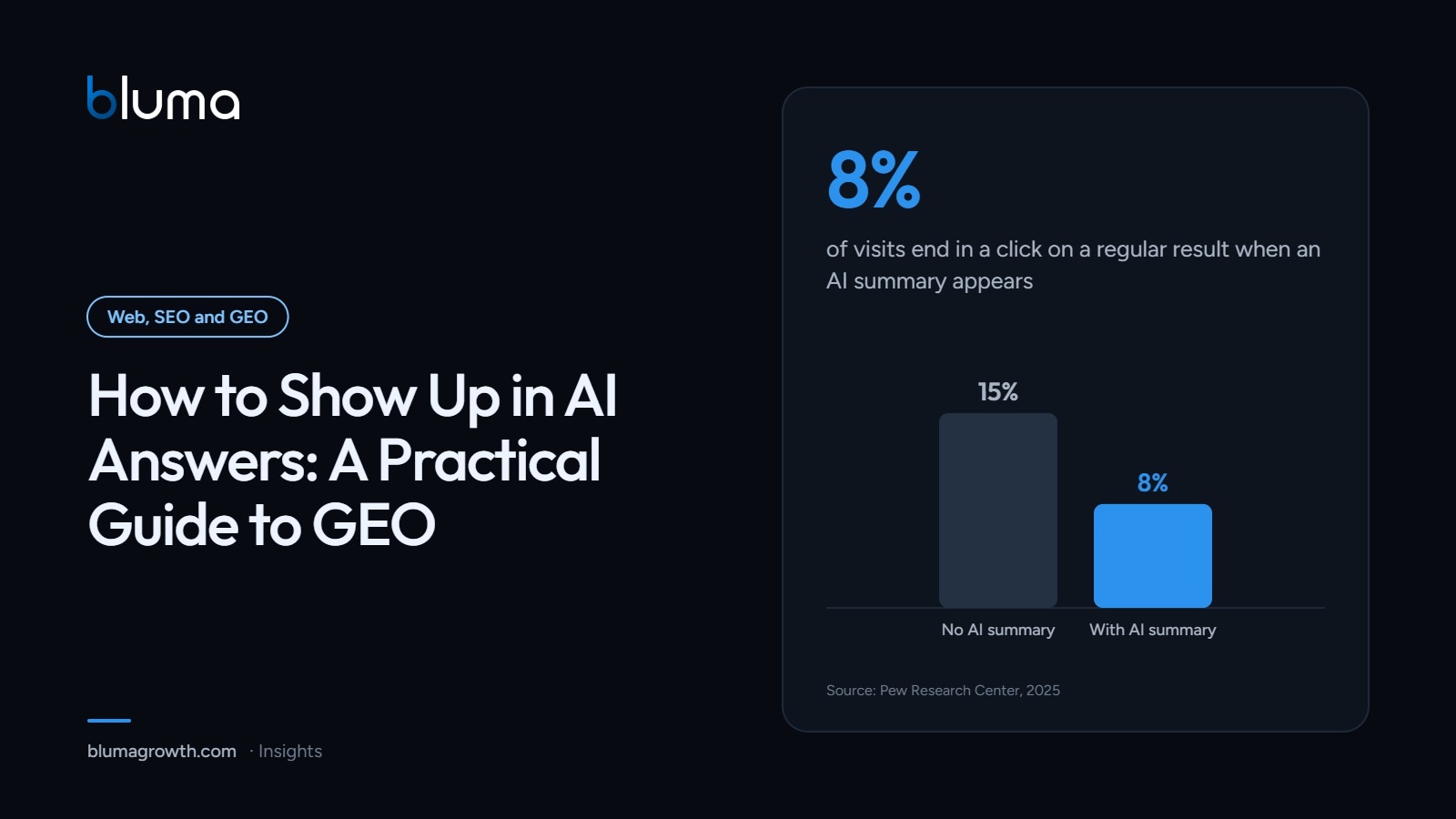
The effect on traffic is measurable. Pew Research Center tracked the real browsing of 900 U.S. adults and found that when an AI summary appeared, users clicked a regular search result on 8% of visits, compared with 15% when there was no summary. Only 1% clicked a link inside the summary itself.
Independent studies point the same way. Ahrefs found that the first organic result gets 34.5% fewer clicks when an AI Overview is present. Seer Interactive measured a 61% drop in organic click-through rate on queries with AI Overviews between mid-2024 and late 2025, but also found that brands cited inside the overview earned about 35% more organic clicks than those that were not. Seer is clear that this is a correlation, not proof of cause, but the direction is useful: being cited is becoming the new ranking.
What GEO is, and what it is not
Generative engine optimization is the practice of making your company easy for AI systems to find, understand, trust and quote. The term comes from a 2024 study by researchers at Princeton and partner institutions, published at KDD, one of the main conferences in data science.
GEO is not a new set of tricks. Google’s own documentation says there are no additional requirements to appear in AI Overviews or AI Mode: a page needs to be indexed and eligible to show a snippet in normal search. In practice, that means GEO stands on top of good SEO. If your site is slow, thin or hard to crawl, no AI-specific tactic will fix it.
What does change is the standard of the content. A search engine ranks pages. An AI system assembles an answer from passages it considers clear, specific and credible. Your job is to give it those passages.
What the research says improves AI visibility
The Princeton team tested nine content changes across thousands of queries and measured how often each source appeared in generated answers. Three findings matter most for a service business.
Evidence beats repetition. Adding relevant statistics, quotations from credible people and citations to sources were among the most effective changes. Stuffing keywords performed worse than doing nothing.
Smaller players gain the most. Sites that ranked lower in traditional search benefited far more than the top result. In one test, the fifth-ranked site gained 115% visibility by citing sources, while the first-ranked site lost ground. For a company that will never outspend national brands on SEO, that is good news.
Clarity is a ranking factor in practice. Passages that state a fact plainly, with a number and a source, are easier for a model to lift into an answer than marketing copy that circles the point.
Five signals to build, in order
- Consistent business facts everywhere. Your name, services, city, service area and what makes you different should read the same on your website, Google Business Profile, directories and social profiles. Inconsistent information gives a model a reason to leave you out.
- One clear page per service. Each page should say who it is for, what is included, how it works, what it typically takes and answer the questions buyers actually ask. A single “Services” page with six bullet points gives an AI system nothing to quote.
- Specific evidence. Replace “high quality” and “years of experience” with facts: how many projects, average timelines, the standards you follow, named people on your team and the sources behind any number you use.
- Mentions you don’t control. Reviews, local press, industry associations and partner pages tell AI systems that other people vouch for you. Google says reviews help local prominence; the same third-party signals feed AI answers.
- Technical access. Make sure your pages are indexable, load fast on mobile and use structured data (organization, services, FAQs) so machines can read what a person sees.
Try this today. Ask two different AI assistants: “Who are the best [your service] providers in [your city], and why?” Write down who is named, what reasons are given and which websites are cited. That list is your real competitive set in AI search.
How to measure GEO without guessing
AI answers change from one session to the next, so a single test proves little. Treat it like a panel:
- Keep a fixed set of 10 to 20 prompts that mirror how buyers ask: by service, by city, by problem and by comparison (“X vs Y”).
- Run them monthly in the assistants your buyers use, and record whether you are mentioned, in what position and with which sources.
- Track AI referrals in your analytics. Many platforms now separate traffic from AI tools; HubSpot, for example, reports “AI referrals” as its own source.
- Watch branded search and direct inquiries. When AI answers mention you without a click, the effect often shows up later as people searching your name.
A 30-day plan
| Week | Focus | Output |
|---|---|---|
| 1 | Baseline | Prompt panel run, list of competitors cited, audit of your business facts across the web |
| 2 | Foundations | Business facts corrected everywhere, Google Business Profile completed, structured data added |
| 3 | Service pages | Your two most profitable services rewritten with clear answers, evidence and sources |
| 4 | Proof and mentions | Review request process running, two third-party mentions pursued, second prompt panel run |
None of this requires a new tool. It requires deciding what you want to be known for, saying it the same way everywhere and backing it with facts. That is positioning work as much as technical work, which is why GEO belongs in your marketing strategy, not only in your SEO checklist.
See what AI says about your company. Bluma’s free assessment runs a live AI test for your service and city, checks your website against two competitors and gives you a 90-day plan.
Sources
- Aggarwal et al., “GEO: Generative Engine Optimization,” KDD 2024
- Alphabet, Q2 2025 earnings call remarks
- Pew Research Center, “Google users are less likely to click on links when an AI summary appears,” July 2025
- Ahrefs, “AI Overviews reduce clicks,” April 2025
- Seer Interactive, “AIO impact on Google CTR,” September 2025
- Google Search Central, “AI features and your website”
- BrightLocal, Local Consumer Review Survey 2026
- HubSpot Knowledge Base, traffic source properties