
Key takeaways
- AI adoption is no longer the question: most companies use it somewhere. The gap is between using AI and getting better results from it.
- Controlled studies show large gains on the right tasks and worse results on the wrong ones. Knowing the difference is the skill.
- In a service business, AI pays off fastest in research, first drafts, repurposing, response speed, data hygiene and reporting.
- Positioning, factual claims and anything that touches trust still need a person who owns the decision.
Ask ten owners of service businesses whether they use AI in marketing and most will say yes. Ask whether it has improved their results and the room gets quieter. That gap is the subject of this article: where AI actually moves the numbers in a firm that sells expertise, and where it quietly makes things worse.
Adoption is high. Results are uneven.
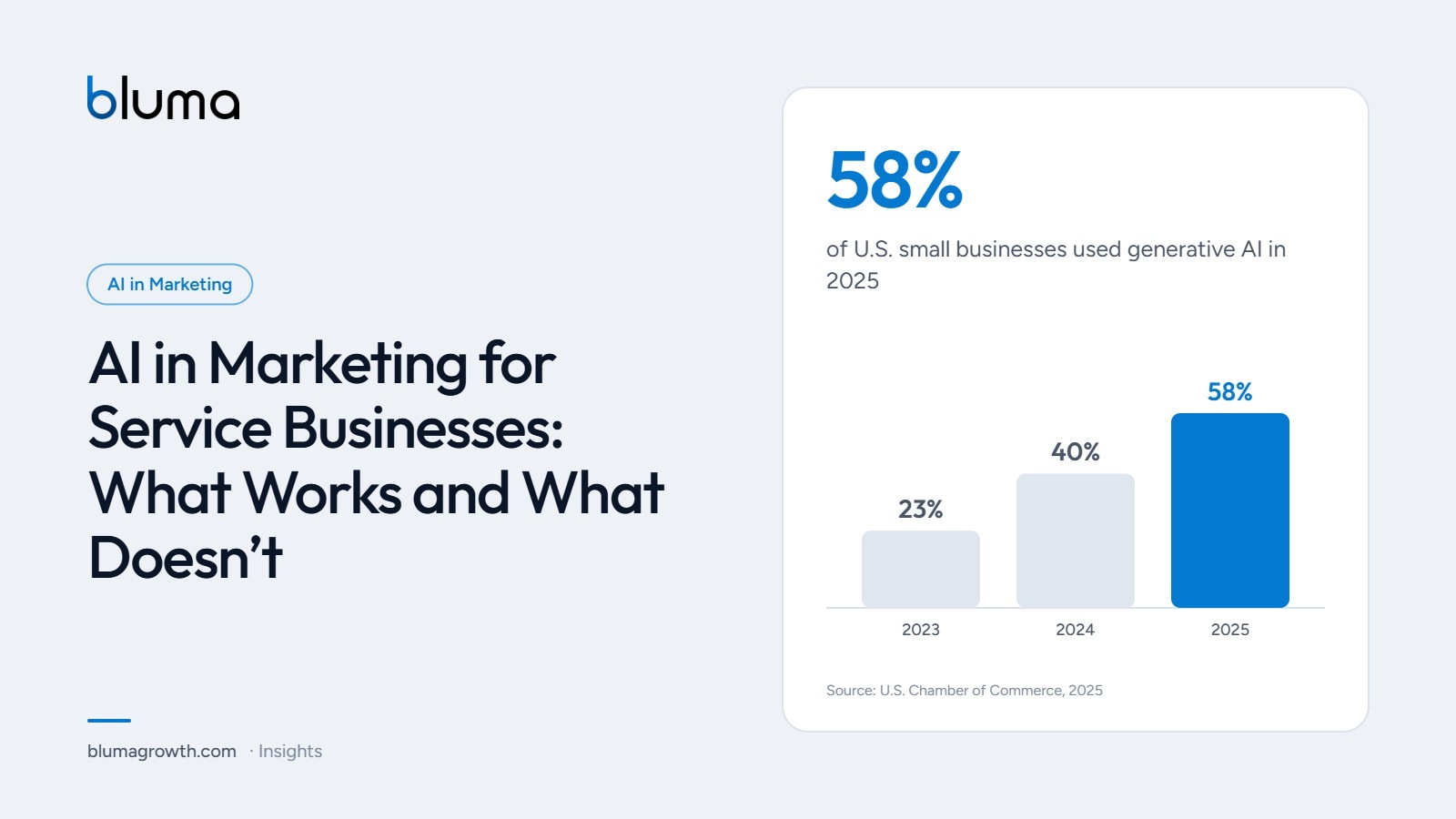
The U.S. Chamber of Commerce reports that 58% of small businesses used generative AI in 2025, up from 40% in 2024 and 23% in 2023. Among marketers specifically, Salesforce’s 2026 State of Marketing found that 75% have adopted AI.
Results tell a different story. McKinsey’s 2025 State of AI survey found that 88% of organizations use AI in at least one business function, but only 7% have fully scaled it. The Content Marketing Institute found that about nine in ten B2B marketers use AI to create content, yet fewer than four in ten say it has improved their content’s performance.
The jagged frontier: where AI helps and where it hurts
The most useful evidence comes from controlled experiments. In a study by researchers from Harvard, MIT, Wharton and Boston Consulting Group, 758 BCG consultants used GPT-4 on realistic tasks. On tasks within the model’s capabilities, they completed 12.2% more tasks, 25.1% faster and with more than 40% higher quality. On a task outside those capabilities, consultants using AI were 19 percentage points less likely to reach the correct answer than those working without it.
The researchers called this a “jagged frontier”: AI is excellent at some tasks and confidently wrong at others that look similar. A separate study of 5,179 customer support agents, published by the National Bureau of Economic Research, found a 14% productivity gain on average and 34% for the least experienced workers. AI raised the floor most for people who were still learning.
The lesson for a service firm is practical. AI is a strong assistant for structured, repeatable work that someone checks. It is a poor substitute for judgment on questions where being wrong is expensive.
Where AI pays off in a service business
| Task | How AI helps | What a person still owns |
|---|---|---|
| Market and competitor research | Summarizes competitors’ websites, reviews and offers in minutes | Deciding what the findings mean for your positioning |
| First drafts | Turns an outline and your notes into a usable draft of a page, email or post | Facts, examples, voice and the final edit |
| Repurposing | Turns one webinar or article into posts, emails and FAQs | Choosing what is worth repeating |
| Ad variations | Generates headlines and descriptions to test | Claims, compliance and which offer to promote |
| Lead response | Drafts instant replies and routes inquiries by type | The conversation that wins the client |
| CRM hygiene and reporting | Cleans records, summarizes calls, explains monthly numbers in plain language | The decisions the numbers should drive |
Where AI fails, and what it costs
- Positioning. A model averages what it has seen. Ask it to describe what makes you different and it will produce the same sentence your competitors get. Differentiation is a decision, not a draft.
- Unverified claims. AI produces fluent text with numbers that may not exist. Every statistic in your marketing should link to a source you have opened yourself.
- Generic content. Content that anyone could have generated gives buyers no reason to trust you, and gives AI answer engines nothing specific to cite.
- Trust shortcuts. The U.S. Federal Trade Commission’s 2024 rule explicitly bans fake reviews, including AI-generated ones, with civil penalties for violations.
- Client data. Pasting client information into consumer tools can break confidentiality agreements. Use business accounts with clear data terms.
Five rules for using AI well
- Start from strategy, not from the tool. Define your positioning, your buyer and your offer first. AI executes a clear brief well and a vague one badly.
- Give it your material. Your best proposals, case notes, recorded calls and FAQs produce far better output than a blank prompt.
- Keep a human editor on everything public. Facts, tone and claims are checked by someone who answers for them.
- Measure output by business results. Count inquiries, response time and close rate, not the number of posts produced.
- Automate the boring parts first. Response templates, routing, data entry and reports free hours without putting your reputation at risk.
Try this. Take your last five won proposals and ask an AI assistant to list the reasons clients gave for choosing you. Then compare that list with your homepage. The gap between them is usually your most valuable rewrite.
Gartner’s 2026 CMO Spend Survey found that marketing leaders now put a meaningful share of their budgets into AI, yet only a minority feel ready to scale it. The companies that pull ahead will not be the ones with the most tools. They will be the ones that pair AI speed with clear strategy and a person accountable for quality.
Find where AI would help your marketing most. The free Bluma assessment maps your brand, visibility and growth across six fronts and shows where to start.
Sources
- U.S. Chamber of Commerce, “Empowering Small Business,” 2025
- U.S. Census Bureau, AI use by businesses, May 2026
- Salesforce, State of Marketing, 10th edition, 2026
- McKinsey, “AI at work, but not at scale,” 2025
- Content Marketing Institute, B2B research, October 2025
- Dell’Acqua et al., “Navigating the Jagged Technological Frontier,” 2023
- Brynjolfsson, Li and Raymond, “Generative AI at Work,” NBER, 2023
- Federal Trade Commission, final rule banning fake reviews, August 2024
- Gartner, 2026 CMO Spend Survey