
Key takeaways
- CRM projects rarely fail because of the software. They fail because of unclear stages, messy data and a team that never adopts the tool.
- Start with one pipeline that mirrors how you actually sell, a handful of required fields and the source of every inquiry.
- Capture inquiries automatically and give every open deal a next step with a date.
- Leave scoring, extra pipelines and complex integrations for later. Adoption first, sophistication second.
Most service businesses that buy a CRM end up with one of two outcomes. Either it becomes the center of how the team sells, or it becomes an expensive contact list that someone updates when they remember. The difference is almost never the brand of software. It is what gets set up in the first month.
Why so many CRM projects disappoint
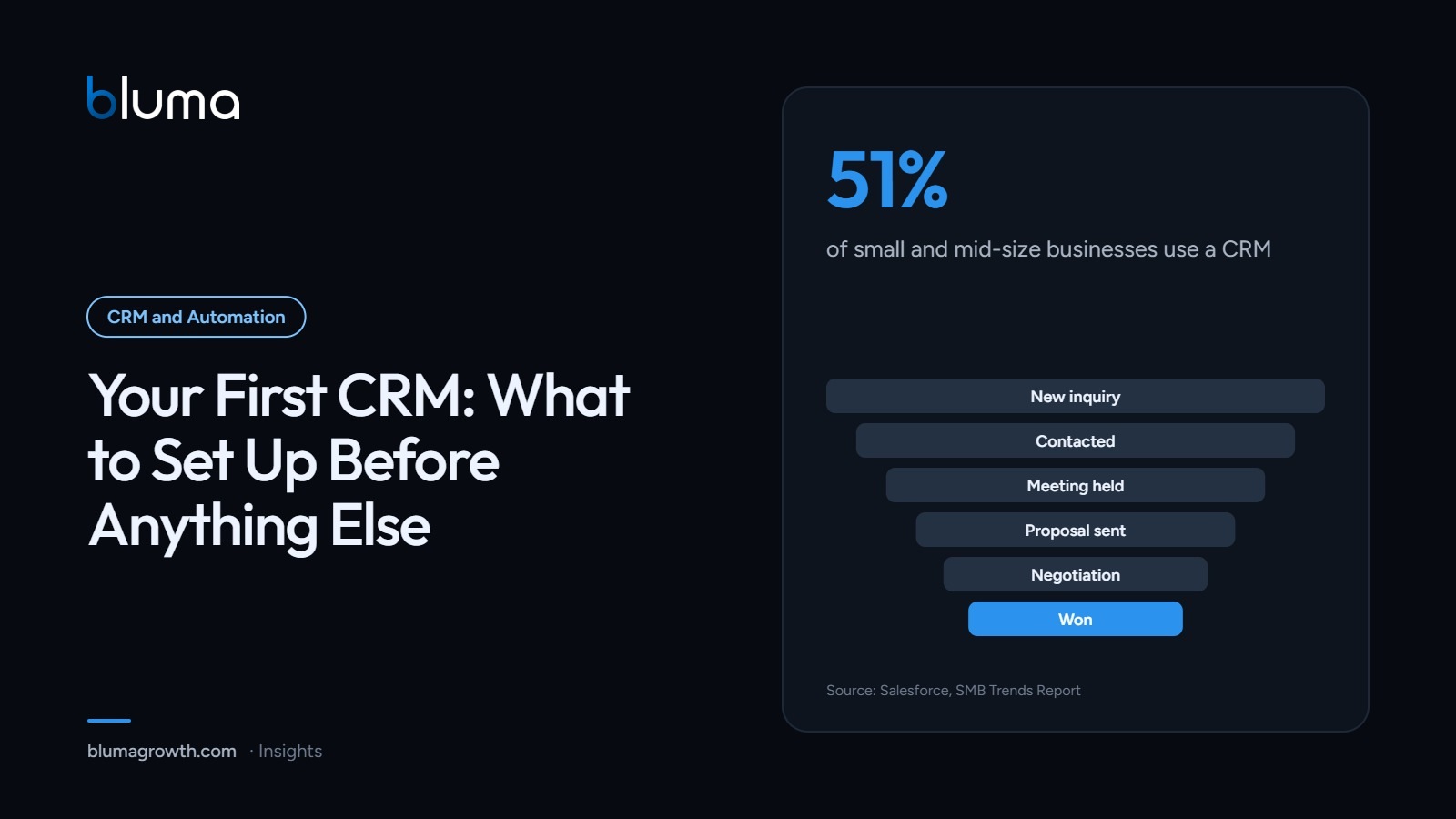
Adoption is widespread but uneven. Salesforce’s sixth SMB Trends Report, based on 3,350 leaders of small and mid-size businesses in 26 countries, found that 51% use a CRM, and 80% said better data quality would increase their revenue. Forrester has reported high CRM adoption alongside low overall satisfaction, and in a separate analysis found that 68% of companies that implemented a CRM struggle to get a single view of the customer and 39% struggle with data quality. It names the root causes plainly: a poorly defined CRM strategy and weak governance and change management.
Gartner summarizes it in one line: CRM platforms are a costly investment, and poor design, implementation and adoption undermine their purpose. Salesforce’s 2026 State of Sales adds the time angle: sales professionals spend only 40% of their week selling and the rest on other work, much of it administrative. A good CRM setup should shrink that admin time, not add to it.
Set up these five things first
- One pipeline that mirrors how you sell. Five to seven stages, each with a clear exit criterion. HubSpot itself recommends separate pipelines only when processes have truly different stages.
- A few required fields. Service of interest, estimated value, source and the date of the next step. Every extra required field lowers the odds your team keeps records current.
- Source on every record. Where did this inquiry come from: Google search, ads, referral, social, events, AI tools or direct? Most CRMs can capture this automatically for web forms; for calls and referrals, make it a required pick-list.
- Automatic capture. Website forms, booking tools and, where possible, calls and messages create records without anyone typing them.
- A next step on every open deal. A task with a date and an owner. A deal without a next step is a deal nobody is working on.
A pipeline for a service business
| Stage | Moves forward when |
|---|---|
| New inquiry | A real person has replied to the contact |
| Contacted | A first conversation happened and there is a fit |
| Meeting held | You understand the need, budget and timeline |
| Proposal sent | The client has received a written proposal |
| Negotiation | The client has responded with questions or changes |
| Won or lost | A signed agreement or a recorded reason for losing |
The lost reason is the most underrated field in any CRM. After three months, “price,” “timing,” “chose a competitor” and “no response” tell you more about your marketing and positioning than any survey.
Try this. Open your CRM, or your spreadsheet, and filter open deals with no activity in the last 14 days. Each one is either a follow-up you can do today or a record you should close as lost.
What to leave for later
- Lead scoring. It needs months of clean data to mean anything.
- Multiple pipelines. Add one only when a service line truly sells differently.
- Dozens of custom fields. If nobody reports on a field, nobody should have to fill it in.
- Connecting every tool. Start with forms, email and calendar. Add the rest once the basics are used every day.
Make adoption the goal
A CRM is only as good as the habits around it. Three rules make the biggest difference: if it is not in the CRM it did not happen; the pipeline is reviewed in a short weekly meeting using the CRM itself, not a separate spreadsheet; and one person owns data quality. After four weeks, you can start reporting on response time, conversion between stages, win rate by source and how long deals take to close.
Check how your follow-up works today. The free Bluma assessment looks at response speed, how you track inquiries and whether you know which channel brings sales.
Sources
- Salesforce, SMB Trends Report, 6th edition
- Salesforce, State of Sales, 7th edition, 2026
- Gartner, CRM sales platform research, December 2025
- Forrester, “High CRM adoption but low satisfaction,” 2023
- Forrester, “Poor change management kills CRM success”
- HubSpot Knowledge Base, set up and customize pipelines
- HubSpot Knowledge Base, traffic source properties