Key takeaways
- Interest decays fast. Research published in Harvard Business Review found that firms responding within an hour were far more likely to qualify a lead than those that waited.
- Most companies are still slow: a 2026 test of 114 B2B companies found an average email reply time of almost 12 hours.
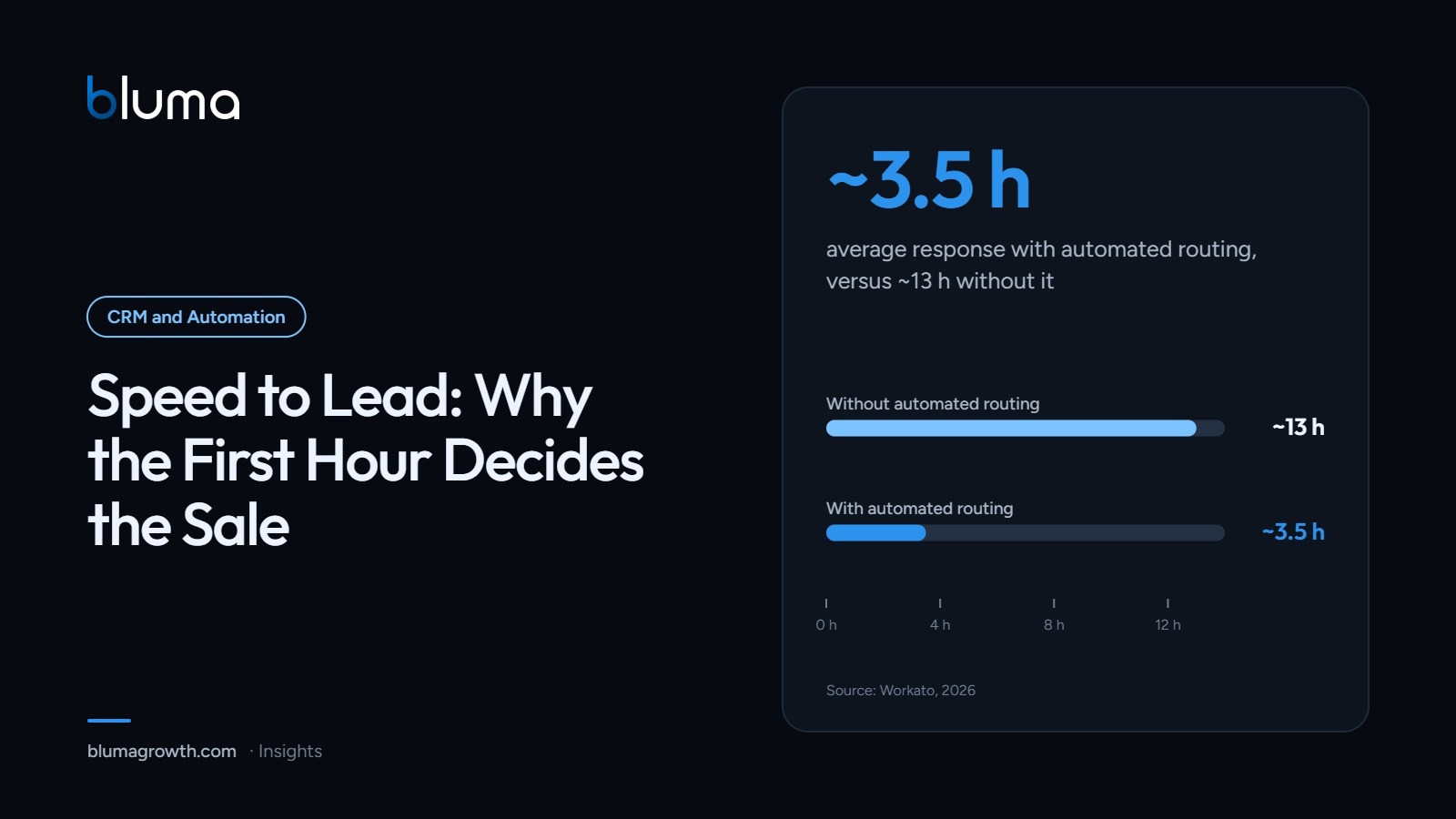
- Automated routing alone cut response times from about 13 hours to about 3.5 in the same test.
- Speed wins the first conversation; persistence wins the rest. Plan several follow-up attempts across channels.
A prospect fills out your form at 4:40 p.m. on a Tuesday. If they hear from you before dinner, you are the company that “got back right away.” If they hear from you on Thursday, you are one of three proposals they are comparing, and perhaps not the first one they opened. Nothing about your service changed between those two scenarios. Only the response time did.
Why the first hour matters
The best-known study on this topic was published in Harvard Business Review in 2011 by James Oldroyd, Kristina McElheran and David Elkington. They audited 2,241 U.S. companies and found that only 37% responded to an online inquiry within an hour, while 24% took more than 24 hours. Firms that tried to contact a lead within an hour were nearly seven times as likely to qualify it as those that waited longer, and many times more likely than those that waited a full day.
A related study by Oldroyd with InsideSales.com reported that calling within five minutes, rather than thirty, made reaching the lead dramatically more likely. Both studies are more than a decade old and the second one comes from a vendor, so the exact multiples should be read with care. The direction has not been contradicted since: the longer a lead waits, the colder it gets and the more likely it has already talked to someone else.
Most companies are still slow
In March 2026, Workato tested lead response at 114 B2B companies by submitting real inquiries. The average personalized email reply took 11 hours and 54 minutes; the average phone follow-up took 14 hours and 29 minutes. Nearly one in five companies never replied by email at all, and only one company replied within five minutes.
The same study found that companies using a lead-routing tool responded in about 3 hours and 32 minutes, compared with nearly 13 hours without one. You do not need a bigger team to be faster. You need a system that puts every inquiry in front of the right person immediately.
Persistence wins the rest
Speed earns the first conversation; most deals need more than one attempt to get there. An older analysis of more than 15 million leads by Leads360 found that a second call raised the chance of reaching a lead by 87% compared with a single call, that around six attempts was the most productive number, and that half of all leads were never called a second time. Channels have changed since 2010, but the gap it describes is still common: one attempt, then silence.
Build a response system, not a heroic effort
- Route every inquiry instantly. Forms, calls, chats and messages all land in one place (ideally your CRM) and notify the person responsible.
- Acknowledge automatically, with a useful next step. A short reply that confirms receipt, says when a person will call and offers a link to book a time.
- Set a human response standard. For example, a personal contact within 15 minutes during business hours and by 9 a.m. the next day otherwise. Write it down and measure it.
- Follow a cadence. Plan five or six touches over about ten days across phone, email and messaging, each one adding something useful.
- Log every attempt. If it is not in the CRM, it did not happen, and nobody can pick it up when someone is out.
- Review the numbers monthly. Median response time, contact rate and close rate by source tell you exactly where inquiries are leaking.
A simple follow-up cadence
| When | Channel | Purpose |
|---|---|---|
| Minute 0 | Automatic email or message | Confirm receipt, set expectations, offer a booking link |
| Within 15 minutes | Phone call | Understand the need and book the first meeting |
| Same day | Personal email | Summarize, share one relevant example or resource |
| Day 2 | Second call and message | Answer questions, confirm the next step |
| Day 5 | Send something useful: a checklist, a case or a short guide | |
| Day 10 | Final message | Close the loop politely and leave the door open |
Try this. Ask a friend to submit an inquiry through your website and through your Google profile this week, without telling the team. Measure how long each takes to get a real reply. That number is your baseline.
Find out where your inquiries leak. The free Bluma assessment checks how fast you respond, how you follow up and whether you know which channel brings sales.