
Key takeaways
- Google Search and Meta do different jobs. Google captures people already looking for your service; Meta reaches people before they start looking.
- Leads from Meta are usually cheaper than leads from Google Search, but intent is lower. Compare cost per sale, not cost per lead.
- If buyers already search for what you sell, start with Google Search. Add Meta (or LinkedIn for B2B) to create demand and stay remembered.
- Automated campaign types work best when they are fed clean conversion data from your CRM.
“Should we be on Google or on Facebook?” is one of the most common questions service-business owners ask, and the wrong way to frame the decision. The two platforms are not competing versions of the same tool. They solve different problems in your buyer’s journey, and the right mix depends on how your clients decide.
Two different jobs
| Google Search | Meta (Facebook and Instagram) | |
|---|---|---|
| What it does | Captures existing demand: shows your ad to people actively searching for your service | Creates demand: shows your ad to people who match your buyer, before they search |
| Buyer intent | High: they typed the problem | Lower: they were scrolling |
| Strength | Fast, predictable inquiries when search volume exists | Reach, repetition and memory at a lower cost per contact |
| Main risk | Expensive clicks in competitive categories | Many contacts that are curious, not ready |
Google describes Search campaigns as a way to show ads “to people actively searching for your products and services.” Meta’s Advantage+ campaigns use automation to find people likely to respond across its apps. One meets demand; the other builds it.
What the benchmarks say
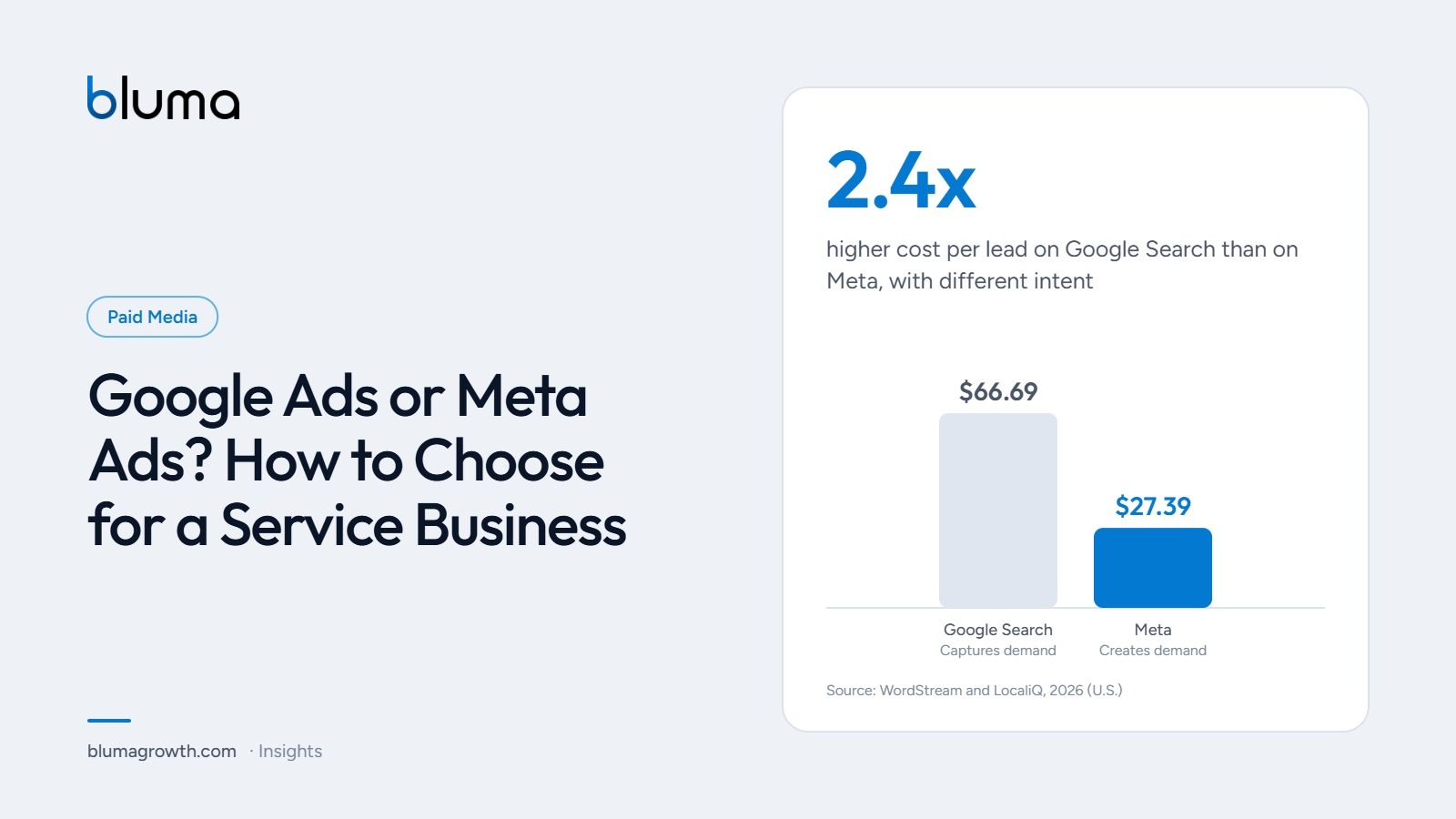
WordStream and LocaliQ analyzed 13,474 U.S. Google Ads search campaigns between April 2025 and March 2026. The median campaign had a click-through rate of 6.64%, a cost per click of $5.42, a conversion rate of 8.18% and a cost per lead of $66.69. LocaliQ’s Facebook benchmarks for lead campaigns report a click-through rate of 2.70%, a cost per click of $1.80, a conversion rate of 8.54% and a cost per lead of $27.39.
Costs vary widely by category. In the same Google data, home and home improvement campaigns had a median cost per lead of $90.92, attorneys $131.63, dentists $72.97 and physicians $40.04. On Facebook, LocaliQ reports $42.95 for home improvement and $61.56 for dentists.
| Category | Google CPC | Google conversion rate | Google cost per lead |
|---|---|---|---|
| Home and home improvement | $8.33 | 8.05% | $90.92 |
| Attorneys and legal | $9.87 | 5.55% | $131.63 |
| Dentists | n/a | 10.67% | $72.97 |
| Physicians and surgeons | n/a | 12.43% | $40.04 |
The lesson is not “Meta is cheaper.” A lead from someone who searched “emergency plumber near me” and a lead from someone who tapped an ad between two videos are not worth the same. The only fair comparison is cost per qualified opportunity and cost per sale, measured in your CRM.
Automation helps, with guardrails
Both platforms now push automated campaign types. Google’s Performance Max reaches all Google inventory, including YouTube, Display, Search, Discover, Gmail and Maps, from a single campaign; Google positions it as a complement to keyword-based Search, and exact-match Search keywords take priority over it. Meta reports that its Advantage+ audience lowered cost per website conversion by 7% and that Advantage+ lead campaigns lowered cost per qualified lead by 10% in its own tests, while noting results are not guaranteed.
Automation optimizes toward whatever you tell it is a success. If every form fill counts as a conversion, including spam and unqualified inquiries, the system will find you more of those. Feed it qualified leads or closed sales from your CRM, and it learns what a good client looks like.
A note for Colombia
According to DataReportal’s Digital 2026 report, Facebook ads can reach about 36.4 million people in Colombia, roughly 68% of the population, while YouTube reaches 31.0 million and Instagram 21.6 million. LinkedIn reports 18 million members in the country, a meaningful audience for B2B services.
How to decide
- Check whether people search for what you sell. If there is real search volume for your service in your city, start with Google Search and a landing page per service.
- Use Meta when the need is not searched yet. New categories, high-consideration services and problems people do not know how to name respond better to demand creation. For B2B, test LinkedIn too.
- Measure cost per qualified lead and per sale. Connect every campaign to your CRM so you see which channel produces clients, not just contacts.
- Capture first, then create. Most service firms should secure the demand that already exists before paying to create more.
- Give every campaign its own page. Sending paid traffic to your homepage is the most common and expensive leak.
Know which channel brings you sales. The free Bluma assessment checks your paid media, your measurement and your follow-up, and shows where to start.