Key takeaways
- Webinars hold attention for close to an hour on average, and professional services webinars see more interaction than most industries.
- In-person experiences speed up decisions: most attendees with hands-on experiences say they accelerated their company’s purchase.
- The common mistake is measuring attendance. Measure meetings, opportunities and revenue from attendees.
- The follow-up decides the result. Plan it before the event, run it within 24 hours and track every attendee in your CRM.
A well-run webinar or event does something no ad can: it puts your judgment in front of many potential clients at once, for long enough that they can see how you think. That is why events remain one of the most effective formats for firms that sell expertise. It is also why so many of them disappoint: the team invests weeks in the event and a single afternoon in what happens after.
Why webinars and events still work
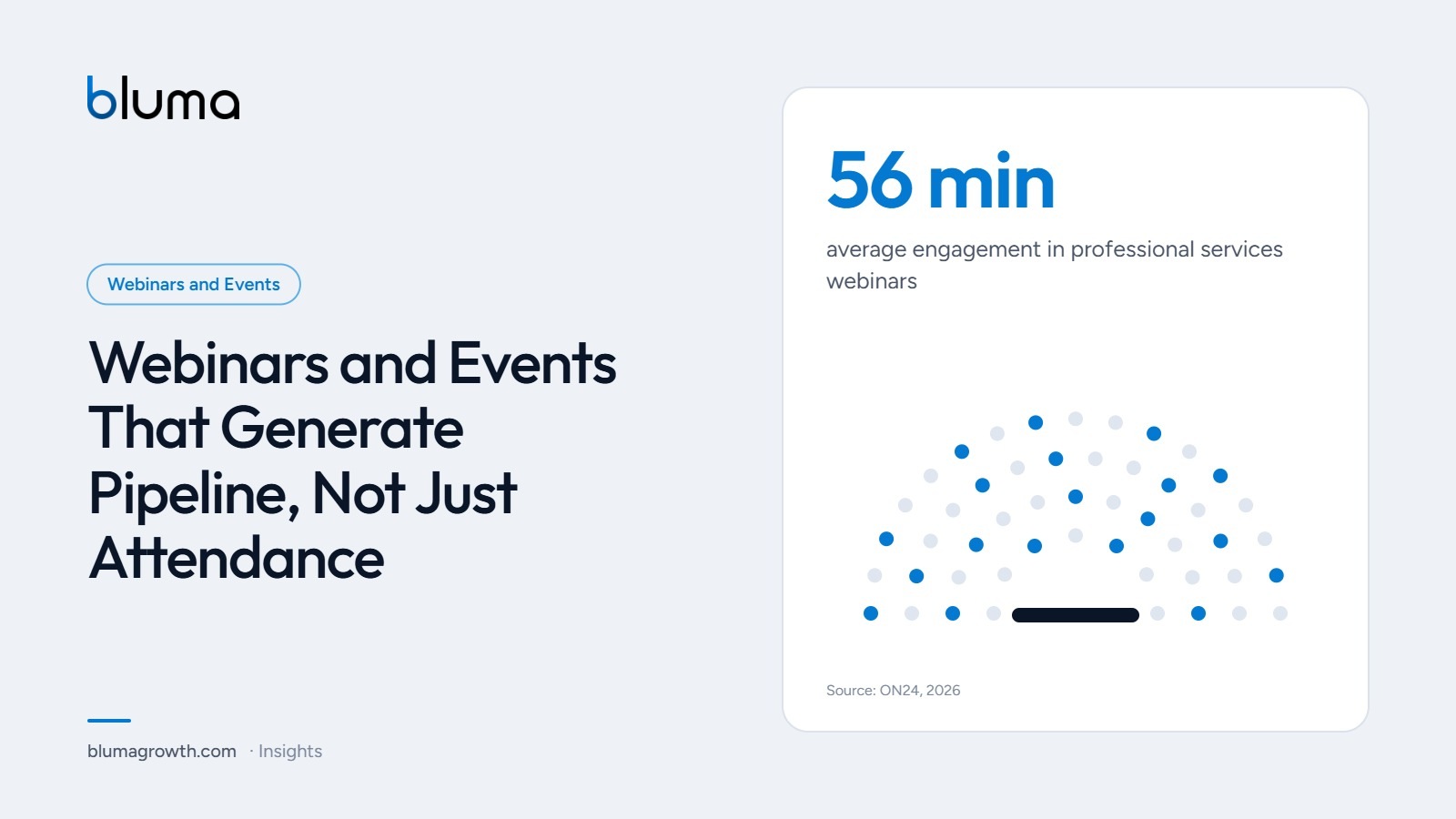
ON24’s 2026 Webinar Benchmarks Report found that attendees engaged for about 50 minutes on average in 2025. In its benchmarks for professional services, the average webinar drew 260 attendees who stayed engaged for 56 minutes and made 2.7 interactions each (questions, polls, downloads), compared with 1.7 across all industries.
In-person formats add something else. Freeman’s 2025 Commerce Report, based on 1,022 attendees and 969 exhibitors, found that 70% of attendees who had hands-on experiences said those experiences sped up their company’s purchase decision, and that 32% of attendees were final decision-makers. The Content Marketing Institute’s 2026 research found that 51% of B2B marketers who measured experiential marketing say it shortens sales cycles.
The mistake: measuring attendance
“We had 180 registrations and 95 attendees” sounds like success, and it says nothing about business. A small event with 25 of the right people and six follow-up meetings can be worth far more than a large one with no next step. Define success before you plan anything: how many meetings, opportunities and clients should this event produce, and from which kind of attendee?
Before: design for the right people
- Choose a real, specific problem. “Marketing trends” attracts students and competitors. “How clinics in Bogotá can fill their schedule without discounting” attracts buyers.
- Invite with a list, not only with ads. Clients, past proposals, partners and your CRM contacts are the most valuable audience.
- Use the registration form to qualify. Company, role and one question about their situation are enough to prioritize follow-up.
- Promote close to the date. An older GoTo analysis of more than 300,000 webinars found that 69% of registrations happened in the final week; plan reminders accordingly.
During: give value and one clear next step
Teach something useful enough that attendees could apply it without you. Use polls and questions to learn about their situation; those answers are qualification data. End with a single, low-friction next step that continues the conversation, such as a diagnosis, a short consultation or a template, rather than a hard sales pitch.
After: the 24 hours that decide the result
| When | Who | What |
|---|---|---|
| Within 24 hours | All registrants | Recording, slides and the promised resource |
| Within 24 hours | Attendees who asked questions or answered polls with a clear need | Personal message and an invitation to a short call |
| Day 3 | Registrants who did not attend | The recording with a two-line summary of the key idea |
| Day 7 | All attendees | A related piece of content and the next event date |
| Day 30 | Sales team | Review meetings, opportunities and revenue from the event in the CRM |
In person: smaller is often better
Bizzabo’s 2025 research found that 78% of event organizers consider in-person events the most powerful way to engage their audience, and 24% named pipeline growth as their top priority. For a service firm, that rarely means a large conference. A breakfast for 15 executives, a hands-on workshop or a client roundtable can produce more qualified conversations than a booth at a trade show, at a fraction of the cost.
Try this. Before your next event, write down three numbers: target attendees from your ideal profile, follow-up meetings and opportunities. Review them 30 days later. If you cannot measure them, set up the CRM fields first.
Check whether events fit your growth plan. The free Bluma assessment maps your marketing across six fronts, including webinars and events, and shows where to start.
Sources
- ON24, Webinar Benchmarks Report 2026
- ON24, Digital Experience Benchmarks for Professional Services, 2026
- Freeman, Commerce Report 2025
- Content Marketing Institute and MarketingProfs, B2B Content and Marketing Trends: Insights for 2026
- GoTo, “The Big Book of Webinar Stats,” 2017
- Bizzabo, the power of in-person events, 2025